A website that can be found, and that records what it catches.
Most small business sites are a brochure with a phone number on it. The useful version is quick on a phone, easy to find, and able to tell you where every single enquiry came from.
- Month to month, no lock-in
- Your own dedicated strategist
- An eight-week strategy plan up front
- Fortnightly reporting in plain English
What web development is, and where it stops being design.
Design decides what a page looks like and what goes where. Development is the part that makes it exist: the code underneath, how fast it loads, whether a search engine can read it, what happens when somebody fills something in, and whether any of it still works on a five-year-old phone with one bar of reception.
You can have a beautiful site that takes eight seconds to appear and loses half the people who tap it. You can also have a fast, well-built site nobody wants to read. They are two different jobs and most problems come from somebody having done only one of them.
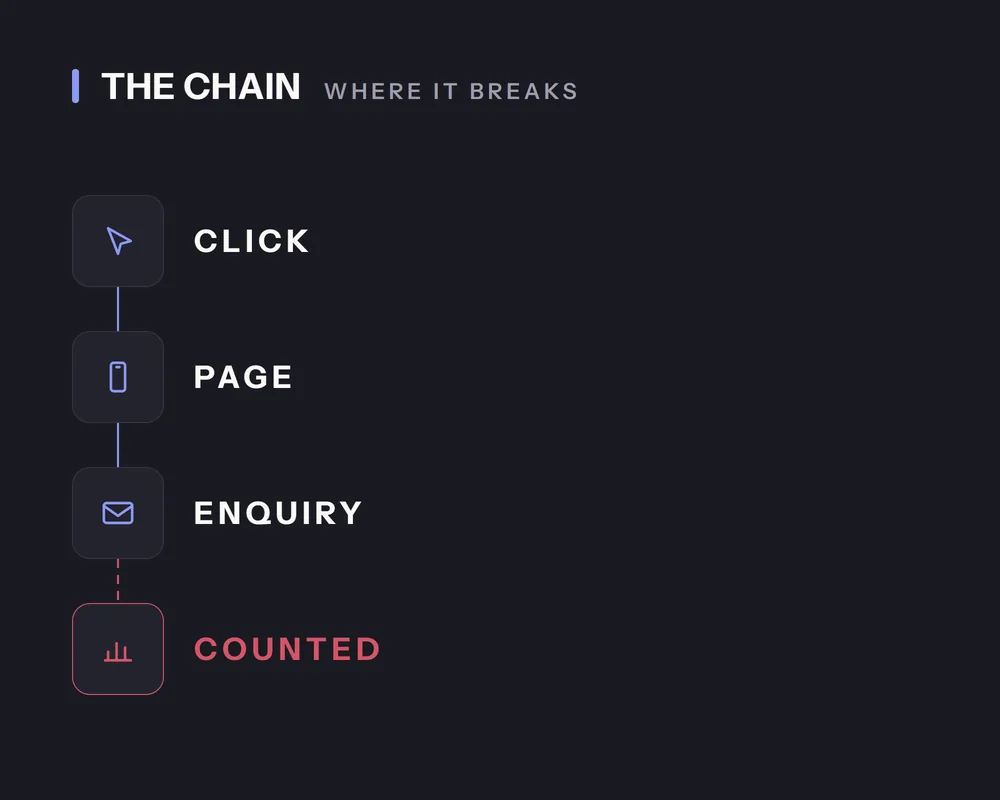
The part almost nobody sells you is the third one: a site that records where its enquiries came from. Without it you have a website that produces enquiries you cannot explain, which is the same as advertising you cannot judge.
What a build includes.
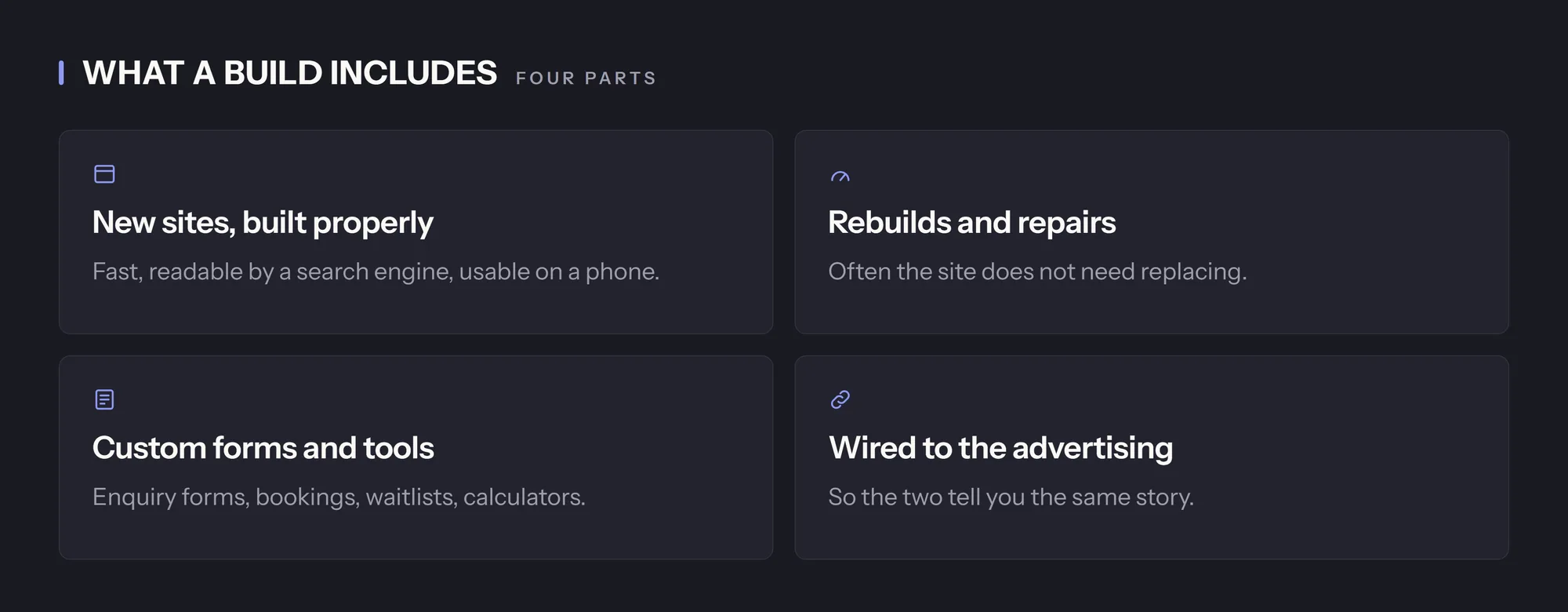
Fast, readable by a search engine, and usable by somebody on a phone in a car park. No page-builder bloat, and nothing you need to call me to change.
Often the site does not need replacing. It needs to stop taking eight seconds to load, or to stop hiding the phone number below three screens of scrolling.
Enquiry forms, tour and appointment bookings, waitlists, quote calculators. Built to do the job AND to record who came from where. Most forms send the email and quietly throw away everything else.
If you are also running ads, the site is built so the two tell you the same story instead of two different ones. This is where most of the money hides.
When people call me about a website.
- The site is old and it shows Slow, awkward on a phone, and quietly costing you the people who would have called if they had got that far.
- You need it to actually do something Take a booking, hold a waitlist, work out a price, put an enquiry somewhere you will see it. This is the one people are told is complicated and expensive, and usually it is neither.
- Enquiries arrive and nobody knows why The phone rings, the form comes in, and there is no way to tell which of them your advertising caused.
- Somebody started it and disappeared A half-finished site and no access to anything. More common than anyone admits, and usually recoverable.
Why me.
- I have to live with what I build I run the advertising that lands on these pages, so a site that loses people becomes my problem within a fortnight. That is a stronger guarantee than anything I could write here.
- You can edit it without calling me Changing your opening hours should not be a support ticket. If you cannot update your own text, you do not really own the site.
- It is yours, including the parts you cannot see The domain, the hosting and the code are in your name. If you want to take it elsewhere you can, and I will help you do it.
- One fixed price, agreed before I start No hourly rate that becomes a surprise. If I misjudge how hard something is, that is mine to wear.
Discovery and structureWeek 1–2
What the site has to do, who it is for, and what every page is for. Written down and agreed before anything is drawn, because this is the cheapest week to change your mind.
DesignWeek 2–4
Laid out flat first, then designed properly. You see it and say what is wrong with it while it is still a picture.
BuildWeek 4–7
The actual construction, including anything it needs to do (forms, bookings, calculators) and the recording that tells you where an enquiry came from.
Testing and launchWeek 7–8
Real phones, real browsers, every form submitted and checked. If we are replacing an existing site, the old addresses are pointed at the new pages so you keep what you had built up.
Thirty days afterIncluded
Anything that turns out to be wrong in the first month is fixed, and it is not a separate invoice.
Quoted as one fixed number, before anything starts.
You get a written price for the whole job after the first conversation, and that is the price. Not an hourly rate that becomes a surprise, and not a quote that grows every time something turns out to be harder than it looked. If I have misjudged the work, that is mine to wear, not yours.
fixed
A single page built to turn a visit into an enquiry. For when the rest of the site is fine but the page your advertising lands on was never built to sell anything. It costs more than a simple page because of what is wired into it: quick on a phone, one clear thing to do, and every enquiry recorded with where it came from.
fixed
The whole site, done once and done properly. Fast on a phone, findable on Google, pages that say what a visitor needs to hear, and every enquiry recorded with where it came from.
Smaller builds, fixes, custom forms and bookings. A tidy brochure site for one location, a form that puts enquiries somewhere you will see them, a booking flow, quoted as one written number after the first conversation.
- Half to begin, half at launch
- Your domain and hosting, in your name, not marked up
- Thirty days of fixes after launch, included
If the scope genuinely changes because you want something that was never discussed, I price that separately and you approve it before I build it. The stages above are for a normal small business site, which runs about eight weeks; a small one runs the same order in roughly half that.
The prices are on the table. The call is for whether the work fits what you need.
How much does a website cost?
The prices are published above: a landing page and a full rebuild at fixed numbers, and everything else from $1,500. Beyond that it depends almost entirely on how many genuinely different pages it has and whether it needs to do anything beyond being read. A tidy site for one location is a very different job from one that takes bookings and holds a waitlist.
You get one fixed number after the first conversation, and it does not move unless you ask for something that was never discussed.
How long does it take?
About four weeks for a small site and about eight for a normal small business one, from the first conversation to being live.
That is slower than a large agency would quote and I would rather be honest about why: they have four people working in parallel and I am one person. What you get for the difference is that the person who designed it is the person who built it, so nothing is lost in between.
Can you fix the site I have instead of replacing it?
Often, yes, and it is usually the better answer. A site that is slow, awkward on a phone or missing a way to record enquiries can normally be repaired for a fraction of a rebuild.
I will tell you which one you need. Recommending the bigger job when the smaller one would do is how this industry earned its reputation.
Can you build a custom form, booking or calculator?
Yes, and it is one of the most valuable things a small site can have. A form that books a tour, a waitlist that captures somebody at the moment they are interested, a calculator that answers the price question people are too shy to ask.
Every one of them is built to record where the person came from, so you can tell which of them your advertising produced.
Will I lose my Google rankings if I move?
Not if it is done properly. Every old address is pointed at its new equivalent so anything that already ranks keeps its place, and so does anyone who bookmarked a page years ago.
This is the single most common way a redesign goes wrong, and it is entirely avoidable. It just has to be done on purpose, before launch rather than after somebody notices the phone stopped ringing.
What is it built on?
Whatever suits the job. There is no one platform I put everybody on, because the right answer for a site that needs to take bookings is not the right answer for an eight-page site that needs to load instantly.
What does not change: it loads fast, you can edit your own words, a search engine can read it, and you are not locked to me or to anybody else.
Who hosts it, and who owns the domain?
You do, both. They are set up in your name with your billing on them, the same as your advertising account. I am given access; I do not hold the keys.
Hosting for a small business site is a genuinely small cost and I do not mark it up.
Fifteen minutes. I will have looked at what you have now before we speak, so it is a conversation and not a pitch.