Fill the places you’re already paying staff for.
The Mondays, the Fridays, the room that never quite fills. Your rent and your educators are paid either way, so the aim is those places, inside a term, without discounting your fees and without lifting your ad budget.
- Month to month, no lock-in
- Your own dedicated strategist
- An eight-week strategy plan up front
- Fortnightly reporting in plain English

Three things quietly waste a centre’s ad budget.
- A call nobody can trace Parents ring far more often than they fill in a form. If those calls aren’t counted, the ads producing them look like they produce nothing, so the budget moves to whatever is easier to measure and the thing that was working gets turned down.
- A page too slow on a phone A parent taps your ad on the way to work. You are charged the moment they tap. If your page is still loading when they give up, you have paid full price for a visit that never happened.
- Ads for care you don’t offer A long day care centre paying for “after school care” searches, or the reverse. The click costs exactly the same and the enrolment was never coming.
None of it looks like a problem. The ads keep running, the invoice keeps arriving, and the rooms fill a bit slower than they should.Why it goes unnoticed for years
The same budget, pointed at the rooms that need it.
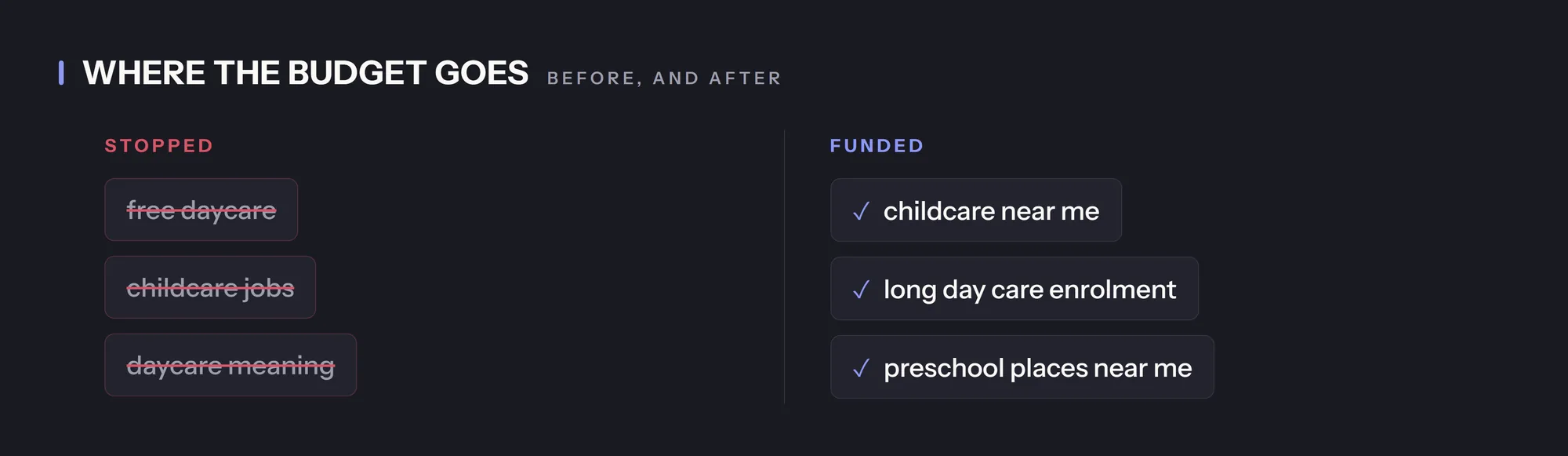
- Soft days filled first A centre that turns families away on Tuesday does not need more Tuesday enquiries. The ads lean into the days with places in them (your Mondays, your Fridays, the room upstairs) and stop paying full price to be told no.
- Only the care you offer, only where you are Every dollar on searches for care you actually provide, from suburbs a parent could actually drive from each morning. No after-school-care clicks for a long day care centre, and no paying to be seen across half the city.
- Enquiries you can point at Every enquiry traced back to what caused it, so you know which suburbs, which words and which times of year actually fill rooms, and which ones you have been paying for out of habit.
- One filled place, in dollars At $150 a day, three days a week, one child is about $1,950 a month, and the staff and rent were paid either way. One filled place funds a lot of advertising, which is why the waste never looks big enough to chase on its own.

Four kinds of centre get the most out of this.
The price a buyer pays moves with how full the centre is and how long it has stayed that way. Rooms filled a year before you go to market are worth more than anything you could renovate.
There is a launch budget in the plan and no reputation yet. Ads are how a centre nobody has heard of gets its first families through the door for a look. The tracking, set up on day one, tells you what every one of them cost.
A handful of centres and one person deciding for all of them. What works at one site usually works at the others, and finding it once is most of the job.
The chains bid on your suburb with head-office budgets. You do not need to outspend them. You need every one of your dollars pointed at parents they are wasting theirs on.
I worked in a service before I ever ran an advertisement.
Five years in outside school hours care. I know what a Monday looks like from your side of the desk, and I know you do not have an afternoon spare to learn advertising.
Then I started running my own businesses and doing my own Google Ads, and kept seeing centres like the one I worked in either paying an agency well over the odds for work no senior person ever touched, or running the ads themselves and getting very little back. That is why I serve this industry rather than any other.
The person you speak to is the person in the account. There is no junior to hand you to and no account manager in between. And because I build websites as well as run ads, the two halves of the same job stop blaming each other.
What I will not do is promise you a number of enrolments. Nobody controls what the parents of your suburb search for next month, and anyone who says otherwise is guessing with your money. What I can show you is what happened on a real account:
60% was going to searches that could never produce a customer
$3,000 a month saved
$36,000 a year saved
That is one account, not a promise. What yours would look like depends on what you sell and who else is bidding.
What happens once I start, week by week.
You get an eight-week plan, in writingWeek 1
An eight-week plan handed over at the start: what happens when, and what you should be seeing by which week. Enrolments take weeks to move, and a quiet fortnight with a plan reads very differently to a quiet fortnight without one.
Tracking gets fixed firstWeeks 1–2
Before a single ad changes, I make sure an enquiry that came from an ad is recorded as one: forms, calls and the pages they land on. In most accounts I look at, it is not. Until that is fixed, nobody can say which half of the budget is doing the work, so it gets fixed first.
The budget moves to the right searchesWeeks 2–8
Budget off the searches that were never going to enrol anyone, onto the suburbs, days and rooms that need filling. Small changes every week, not a big bang and a long wait.
Enrolments follow, four to ten weeks inWeeks 4–10
Enquiries move first, tours follow, children start last, usually four to ten weeks after the work begins, longer outside the October-to-February season when most families look. I will not pretend that lag away; the roadmap exists because of it.
Then, every fortnight, the same four numbers in the same order:
- Spentwhat actually left your account, in dollars
- Enquirieshow many parents reached you, and from where
- Tourshow many of those walked through your door
- Children startedthe headline, which the other three exist to explain
No clicks, no charts to decode, no dashboard to learn. If a fortnight was poor I will say it was poor, and what I am doing about it.
Fifteen minutes about your rooms, your days and your budget.
Every price, published.
Nothing here is a quote-on-application. These are the prices, so the call can be about your centre instead of a negotiation.
one time
A written report on your own ad account. Where the money is actually going, search by search and in dollars; what isn’t being counted; and exactly what to change. It is yours to keep and yours to action. You implement it, not me.
If you move to ongoing management within thirty days, the $750 comes off your first month. In writing, credited once.
per month
Everything done for you, every month. The ads run, the budget moves every week, and every fortnight you get the four numbers above. Month to month, no lock-in, and the account stays in your name.
Set up properly in the first fortnight, included:
- Tracking installed, so an enquiry from an ad is counted as one ($750 sold on its own)
- Your enquiry form checked and fixed ($500 on its own)
- Your Google Maps listing fixed ($600 on its own)
fixed
A single page built to turn an ad click into an enquiry. For when the rest of the site is fine but the page the ads land on was never built to enrol anyone. Quick on a phone, one clear thing to do, and it records where every enquiry came from.
fixed
The whole site, done once and done properly. Fast on a phone, findable on Google, every page saying what a parent needs to hear, and every enquiry recorded with where it came from.
per month
The pause option, instead of cancelling. Over the quiet months the account stays warm and the history stays intact, and when a parent searches your centre’s name, it is your ad they find there, not a competitor’s.
The prices are on the table. The call is for whether it fits your centre.
Sometimes the right answer is: don’t hire me.
Some of these calls end with me saying exactly that. Here is when.
- Your ad budget is under about a thousand dollars a month. My fee would rival the spend it manages, and nobody should pay a dollar of management for every dollar of ads. At that size the audit or the enrolment page is the honest buy. Both are built so you can act on them without me.
- Your rooms couldn’t take the families. If ten families rang next month and no room could take one of them, advertising would fill your inbox and change nothing. That is a roster problem, and ad money spent before it is fixed is burned. Fix the staffing first. The ads will still be here.
- Your website loses them first. If the page your ad lands on takes eight seconds to load on a phone, ads mostly pay to prove it. Fix the page first. It is the smaller, cheaper job, and it makes every later ad dollar work harder.
- You want a promised number of enrolments. I will not give you one, and I would be wary of whoever will. Nobody controls what the parents of your suburb search for next month. What you get here is the work, the four numbers every fortnight, and a straight answer when something is not working.
Not sure which of these is you? That is what the fifteen minutes is for.
Month to month, and the account stays yours.
No lock-in and no minimum term. The Google account is in your name and stays in your name whether we work together for a year or for a month. If you ever leave, you leave with everything, including the history.
What does it cost, all in?
The prices are published in full above: the audit, the monthly management, the two website jobs and the off-season option. The only number not on this page is your ad budget, which is yours: spent with Google directly, never marked up, never touched by me.
Those are the amounts you pay, and nothing is locked in.
How soon do rooms actually fill?
Enquiries usually move inside the first month. Enrolments take longer. A parent enquires, tours, thinks, and then starts, and that chain runs four to ten weeks even when everything works.
That is why the eight-week roadmap is handed over on day one: so the weeks in between are legible instead of silent. The calendar matters too. Most families look between October and February, so work started before spring lands in the season it needs.
How much ad budget do I need?
Enough that my fee makes sense against it. As a rule, the fee should never exceed what you spend on the ads themselves. Under that line, monthly management costs more than it can move.
If that is where your budget is, say so on the call and I will point you at the audit or the page instead. No hard feelings either way.
What do the updates look like?
Four numbers, every fortnight, in the same order: spent, enquiries, tours, children started. A few plain sentences on what changed and why.
No dashboard to learn, no charts to decode, and nothing that needs a marketing dictionary. If a fortnight was poor, the update says so.
Do you only run Google ads?
Google is where a parent who needs care this year is actually searching, so it is where a centre’s money works hardest. I also run YouTube and Meta (see paid ads), but I will not spread a small budget across three platforms to look busy.
What happens if I want to stop?
You say so, and that month is the last month. No exit process, no wind-down fee. The account, its history and everything in it stay in your name, because they were never in mine.
Centres that go quiet over summer often do not need to stop at all. The off-season option in the prices above keeps the account warm and your centre’s name defended for less than the cost of cancelling and starting again.
Who actually does the work?
Me. The person on the call is the person in the account: no juniors, no handovers, no account manager relaying messages. Nothing about your centre gets lost between people, because it never passes through any.
What exactly is in the audit?
Where your money is going, search by search and in dollars; what is not being counted; and what to change, in plain words. It is a written report and it is yours. Plenty of directors action it themselves and never pay me again, which is a perfectly good outcome.
And if you do move to ongoing management within thirty days, the audit price comes off your first month.
My last agency didn't work out. Why would this be different?
I cannot speak for them. But in most accounts I look at, the counting was never set up, so nobody, including the agency, could tell which half of the budget was working. That is why the first fortnight here goes on counting rather than promises.
The structure is different too: month to month, and the account stays yours, so leaving me is as easy as leaving them should have been.
When is the best time to start?
Before the season, not during it. Most families look for care between October and February, so an account tuned by spring catches that wave instead of chasing it.
Starting in the quiet months is not wasted either. That is when the tracking and the landing page get fixed without pressure.
Fifteen minutes about your centre. If it turns out nothing is wrong, I will tell you that and we can both get on with the day.